
A recent study published in journal of Genome Biology sheds light on a fundamental regulatory mechanism governing germ cell development yielding significant implications for reproductive biotechnology. This is an international and interdisciplinary joint study lead by Professor Shau-Ping Lin’s group at Institute of Biotechnology. The research uncovers novel insights into how specialized small non-coding RNAs secure accurate germ cell development across animal species.
Reproductive efficiency and fertility represent the most vital traits in livestock production, understanding universal molecular safeguards in germ cells offers powerful applications for animal breeding. During embryonic development, primordial germ cells undergo global epigenetic erasure, exposing the genome to transposon activation. While the PIWI-interacting RNA (piRNA) pathway is well-known for transposon defense, its broader regulatory role in germline development remains unclear, Profiling germline piRNAs during epigenetic reprogramming revealed that a major portion maps directly to enhancers, particularly super-enhancers, which act as master genetic switches governing cell fate. Crucially, extensive cross-species comparative analyses demonstrated that this piRNA-enhancer association is deeply conserved across chicken, murine, and human models. This evolutionary conservation highlights an ancient, universal mechanism shared across vertebrate lineages to safeguard germline integrity.
Many of these germline piRNAs map to enhancers that are normally active in somatic (non-germline) lineages. The authors propose a vital surveillance role: these piRNAs modulate enhancers themselves and enhancer RNA (eRNA) turnover, actively repressing untimely somatic gene expression during germ cell development.
Decoding this universal safeguard directly addresses major hurdles in agricultural biotechnology. These insights provide actionable tools to prevent epigenetic drift during in vitro embryo production (IVP), refine assisted reproductive technologies (ART), and optimize primordial germ cell (PGC) transfer techniques—a critical bottleneck in poultry breeding and gene editing. Furthermore, enhancer-associated piRNAs offer novel biomarker-driven platforms to screen elite livestock gamete quality, boost herd fertility, and advance the long-term genetic preservation of endangered or high-value animal breeds.
Genome Biol. 2026 Jun 11;27:256. doi: 10.1186/s13059-026-04142-7
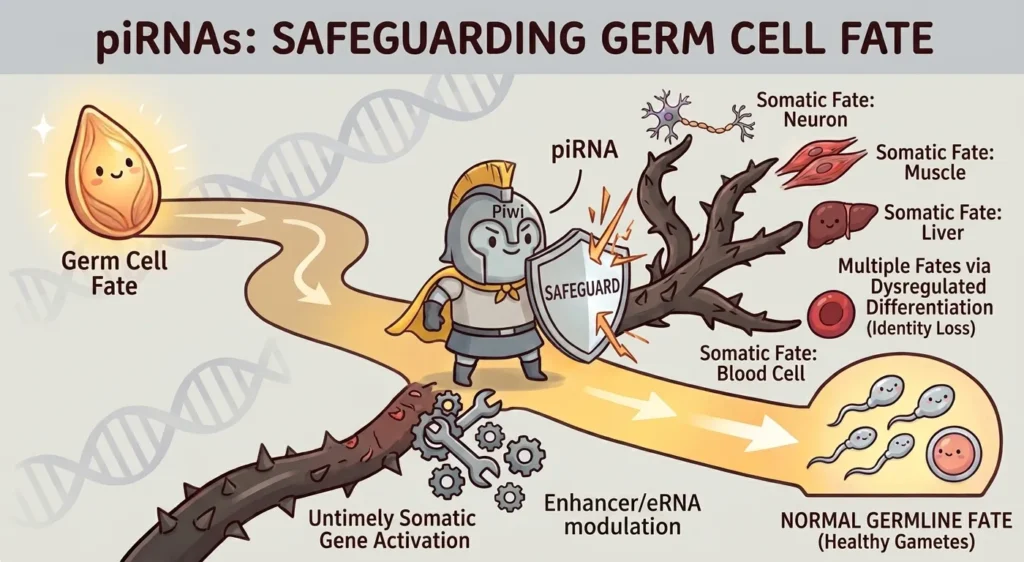
Schematic model of piRNAs safeguarding germ cell fate.
Developing male germ cells progress along a restricted trajectory toward healthy gametes, protected by the Piwi–piRNA complex against untimely somatic gene activation. Potentially mediated through the modulation of somatic enhancers and enhancer RNAs (eRNAs), piRNAs suppress alternative somatic lineages (e.g., neuronal, muscular, hepatic, or hematological), thereby preventing dysregulated differentiation and preserving germline identity during spermatogenesis.